

Community Information
Friday, January 25, 2013
Pet of the Week

Wednesday, January 23, 2013
Wednesday, July 13, 2011


Tuesday, June 7, 2011
Pets of the Week
 Meet Bud and Lou, a pair of playful little guys looking for a home. They are 7 weeks old and have been neutered. Bud and Lou are just a few of the animals ready for adoption at the Louisville Animal Shelter. The Shelter is currently over capacity with cats, kittens and large dogs. That means dogs like Goldie need to find a home. She's just one year old and has been spayed and ready for a new owner. For more information on these pets or other animals at the shelter, please call the Louisville Animal Shelter at 662-773-4320 or visit us on 110 Thompson St. Thank you

Goldie
Tuesday, May 10, 2011
Canton Flea Market Scheduled for Thursday
The Canton Flea Market is scheduled for Thursday- May 12th. The event is one of the largest in the South and has become a traditional trek for many local folks since its inception in 1965. Arts and Crafts have become the major component of the market and draws roughly 1000 artists and craftsmen to the event centered around the old Courthouse Square in downtown Canton. The Market is held on the 2nd Thursday in May and again in October.
While its too late for participation in the May event, applications for vendors for October can be found online at
http://www.cantonmsfleamarket.com/
While its too late for participation in the May event, applications for vendors for October can be found online at
http://www.cantonmsfleamarket.com/
Friday, May 6, 2011
Winston Co. Not Yet Included in Federal Disaster Program
 The Mississippi Emergency Management Agency and the Federal Emergency Management Agency announced today more than $1.6 million in federal and state aid has been approved for Mississippi storm survivors in 11 counties but at this point (11:30 am, 5-6-11), Winston County is not included. As of Wednesday evening 1,043 residents in Chickasaw, Choctaw, Clarke, Greene, Hinds, Jasper,Kemper, Lafayette, Monroe, Neshoba and Webster were approved for a total of $1,627,076 for the Individuals and Households Program.
The proper paperwork and procedures have been followed by county personnel and is currently in federal hands. Winston Co. Emergency Management Director Clarence Kelly indicated today that MEMA (Mississippi Ememergy Management Agency) had informed him that the paperwork was sitting in Washington waiting for review and that it was likely to be approved. If included in the Federal Disaster program, residents of Winston County would be eligible for numerous types of financial aid in grants and SBA loans.
Individual assistance for eligible homeowners and renters can include grants to help pay for rental housing, home repairs and other serious disaster-related expenses not met by insurance or other assistance programs. Representatives are available to explain the full range of application options available including assistance for public transportation expenses, medical and dental expenses, and funeral and burial expenses.
Low-interest loans from the SBA are available for eligible applicants to cover residential and business losses not fully compensated by insurance. Among the options are assistance for replacement of personal property, vehicle repair or replacement, and moving and storage expenses. Other help at the centers may be provided by attorneys, crisis counselors and representatives of organizations such as the American Red Cross or local volunteer agencies.
William McCully & press releases
Friday, April 29, 2011
Webster County Needs After Storm Damage
This is an open letter asking for assistance after April 27th's storm and tornado damage in Webster County:
Cumberland Baptist Church is a mile off of Hwy 15 and right across from our school that was destroyed by the tornado. It is also feeding station for victims and workers daily and providing water, coffee and snacks all day. They are asking for paper plates, cups, napkins, plastic cutlery, and Styrofoam to-go style boxes. They can also use the large aluminum pans that food can be prepared in. There is a current need for bags of individual size chips and sandwich meats. They will also welcome anyone wanting to help prepare the food each day. They are also accepting toiletry items such as soap, shampoo,toothpaste, toothbrushes, deodorant, etc. and clothing is needed too. A contact person at the feeding station at the church is Starla McCarter and her cell # is 662-552-7827There are still many homes without power so ice is also welcome. They also need help putting tarps on houses and cleaning up!
Also, volunteers were to meet at Mathiston First Bapist Church beginning at 8 a.m. Friday morning to map out the clean-up process for Wood Jr. College so that our students from East Webster School will be able to attend school there on Tuesday, May 3. They are asking anyone who can to bring mops, brooms, all cleaning supplies, weedeaters, etc. They are also asking for basic school supplies too, pens,#2 pencils, notebooks, etc. The teachers will also need supplies. The campus of Wood Jr. is still a mess and as of yesterday, there were still power lines down on the campus.
There are so many areas of need right now, but through it all, the Son isstill shining. Thank you in advance for any assistance. Please pray and pray and pray, not just for our community but storm victims and all of the workers out there all over the South and especially for Alabama.
Valerie Palmer662-418-7171 cell
Cumberland Baptist Church is a mile off of Hwy 15 and right across from our school that was destroyed by the tornado. It is also feeding station for victims and workers daily and providing water, coffee and snacks all day. They are asking for paper plates, cups, napkins, plastic cutlery, and Styrofoam to-go style boxes. They can also use the large aluminum pans that food can be prepared in. There is a current need for bags of individual size chips and sandwich meats. They will also welcome anyone wanting to help prepare the food each day. They are also accepting toiletry items such as soap, shampoo,toothpaste, toothbrushes, deodorant, etc. and clothing is needed too. A contact person at the feeding station at the church is Starla McCarter and her cell # is 662-552-7827There are still many homes without power so ice is also welcome. They also need help putting tarps on houses and cleaning up!
Also, volunteers were to meet at Mathiston First Bapist Church beginning at 8 a.m. Friday morning to map out the clean-up process for Wood Jr. College so that our students from East Webster School will be able to attend school there on Tuesday, May 3. They are asking anyone who can to bring mops, brooms, all cleaning supplies, weedeaters, etc. They are also asking for basic school supplies too, pens,#2 pencils, notebooks, etc. The teachers will also need supplies. The campus of Wood Jr. is still a mess and as of yesterday, there were still power lines down on the campus.
There are so many areas of need right now, but through it all, the Son isstill shining. Thank you in advance for any assistance. Please pray and pray and pray, not just for our community but storm victims and all of the workers out there all over the South and especially for Alabama.
Valerie Palmer662-418-7171 cell
Wednesday, February 16, 2011
LFD Joins "Power Those Who Protect Us" Program
CITY OF LOUISVILLE FIRE DEPARTMENT JOINS “POWER THOSE WHO PROTECT US” PROGRAM TO BUILD GREATER AWARENESS FOR VOLUNTEER FIRE DEPARTMENTS NEEDS
Duracell and the National Volunteer Fire Council Launch Battery Donation Program Nationwide
The City of Louisville Fire Department today joined forces with more than 23,000 other volunteer fire departments across the country in the Power Those Who Protect Us battery donation program created by Duracell, in partnership with the National Volunteer Fire Council.
The program helps build greater awareness around the challenges volunteer firefighters face on a daily basis and the need to help support them. Most fire departments in the U.S. are staffed by volunteer firefighters who rely on approximately 20 percent of their funding to come from local fundraising and donations.*
The Power Those Who Protect Us battery donation program lets consumers give back to local volunteer firefighters, like those in Louisville and Winston County who devote countless hours of their free time to protecting our communities. When consumers purchase specially marked Copper Top battery packs, Duracell will make a battery donation to volunteer fire departments to help power communication devices and life-saving equipment. By going to www.duracell.com/protect, donations can also be earmarked to local departments by zip code.
“With the majority of fire departments in the U.S. being staffed by volunteer firefighters, many of which, like us, struggle to find the funding for basic equipment needs,” said Chief Terry Johnson. “We’re asking everyone to help make a difference and purchase specially marked Duracell batteries so our station can receive much needed support to power our communication devices. From personal alert system devices, thermal imaging cameras and personnel location equipment, to radios and flashlights – batteries help power these critical tools.”
For more information about Duracell’s Power Those Who Protect Us program, please visit www.duracell.com/protect.
Duracell and the National Volunteer Fire Council Launch Battery Donation Program Nationwide
The City of Louisville Fire Department today joined forces with more than 23,000 other volunteer fire departments across the country in the Power Those Who Protect Us battery donation program created by Duracell, in partnership with the National Volunteer Fire Council.
The program helps build greater awareness around the challenges volunteer firefighters face on a daily basis and the need to help support them. Most fire departments in the U.S. are staffed by volunteer firefighters who rely on approximately 20 percent of their funding to come from local fundraising and donations.*
The Power Those Who Protect Us battery donation program lets consumers give back to local volunteer firefighters, like those in Louisville and Winston County who devote countless hours of their free time to protecting our communities. When consumers purchase specially marked Copper Top battery packs, Duracell will make a battery donation to volunteer fire departments to help power communication devices and life-saving equipment. By going to www.duracell.com/protect, donations can also be earmarked to local departments by zip code.
“With the majority of fire departments in the U.S. being staffed by volunteer firefighters, many of which, like us, struggle to find the funding for basic equipment needs,” said Chief Terry Johnson. “We’re asking everyone to help make a difference and purchase specially marked Duracell batteries so our station can receive much needed support to power our communication devices. From personal alert system devices, thermal imaging cameras and personnel location equipment, to radios and flashlights – batteries help power these critical tools.”
For more information about Duracell’s Power Those Who Protect Us program, please visit www.duracell.com/protect.
Proper Home Addressing: A Safety Issue
a message from the Louisville Fire Dept.
Have you ever tried to find an address to meet with friends or attend a party or maybe you needed to drop off something important. What was the address? What’s the house number? I can’t see it …….Oh No, we passed it; now we've got to turn around…….
Sound Familiar?
Think of the mail carrier or the delivery driver trying to deliver a package to you……
You dial 911 for an emergency and the Fire Department, Emergency Medical Services, or Police Department are delayed because……… WE CAN’T FIND YOU!
Addressing your home and business is essential to ensure when you need us -we can find you. It is recommended by the International Code Council’s Public Safety Code that an address can be seen from the street and is highly visible. It is recommended that the addressing numbers contrast with the background and are reflective.
If you place the address near the street or on your mailbox, the numbers identifying your address should be on both sides of the sign or mailbox and a minimum of 4” (four inches) tall. This will allow for the address to be seen from at least 100 ft away.
When your address can be seen from the street it allows for better service from everyone you rely on.
ANY QUESTIONS CONTACT
Chief Terry Johnson
City of Louisville Fire Department
Cell 803-662-7654
Email- LFDFire1@mediacombb.com
Have you ever tried to find an address to meet with friends or attend a party or maybe you needed to drop off something important. What was the address? What’s the house number? I can’t see it …….Oh No, we passed it; now we've got to turn around…….
Sound Familiar?
Think of the mail carrier or the delivery driver trying to deliver a package to you……
You dial 911 for an emergency and the Fire Department, Emergency Medical Services, or Police Department are delayed because……… WE CAN’T FIND YOU!
Addressing your home and business is essential to ensure when you need us -we can find you. It is recommended by the International Code Council’s Public Safety Code that an address can be seen from the street and is highly visible. It is recommended that the addressing numbers contrast with the background and are reflective.
If you place the address near the street or on your mailbox, the numbers identifying your address should be on both sides of the sign or mailbox and a minimum of 4” (four inches) tall. This will allow for the address to be seen from at least 100 ft away.
When your address can be seen from the street it allows for better service from everyone you rely on.
ANY QUESTIONS CONTACT
Chief Terry Johnson
City of Louisville Fire Department
Cell 803-662-7654
Email- LFDFire1@mediacombb.com
Saturday, February 5, 2011

Tuesday, December 14, 2010
Flower Ridge Drive Thru Nativity in 28th Year
Flower Ridge United Methodist will once again provide a Living Nativity for the Christmas Season. For 28 years in all kinds of weather, this small church located on Hwy 15 S near Louisville has put together props, costumes and scenery for a drive thru experience of key parts of the birth of the Christ Child.
Church member, Beth Hemphill, indicates that the churh decided to hit upon the 5 key parts of the story of the Christ Child and use the members from the church to stand out in the scenes. The 1st scene is Mary being visited by the Angel and learning that she was with child. The 2nd scene; The Inn is where Jospeh and Mary are turned away because there was no room; The 3rd is The Wise Men traveling to see this Christ Child; The 4th is the angels telling the shepherds of the Birth and the 5th Scene is Mary and Joseph in the stable with the baby.
Hemphill indicates that she has been participating since the age of 8 and everyone who has had something to do with it has always loved it and wants to come back and do it again regardless of the weather.
The drive thru Nativity will be December 22 and 23 from 6 to 8 pm. For more information, contact Beth Hemphill at 662-803-6621 or Bro. Larry Haggard at 662-803-5748."
Church member, Beth Hemphill, indicates that the churh decided to hit upon the 5 key parts of the story of the Christ Child and use the members from the church to stand out in the scenes. The 1st scene is Mary being visited by the Angel and learning that she was with child. The 2nd scene; The Inn is where Jospeh and Mary are turned away because there was no room; The 3rd is The Wise Men traveling to see this Christ Child; The 4th is the angels telling the shepherds of the Birth and the 5th Scene is Mary and Joseph in the stable with the baby.
Hemphill indicates that she has been participating since the age of 8 and everyone who has had something to do with it has always loved it and wants to come back and do it again regardless of the weather.
The drive thru Nativity will be December 22 and 23 from 6 to 8 pm. For more information, contact Beth Hemphill at 662-803-6621 or Bro. Larry Haggard at 662-803-5748."
Thursday, November 4, 2010
What’s Happenin This Weekend
Big weekend here in good ol’ Winston County. Lots’ of ballgames going on –starting tonight as Weir travels down to Noxapater to take on the Tigers in what could be the final game for both teams. The loser is likely eliminated from any post season play and the winner will have to wait to see the results of other games. The game starts at 7 pm and is broadcast by WLSM. Nanih Waiya is assured post season play as they travel down to South Leake for the final regular season game.
Louisville and Winston Academy are both at home as they begin their post season play. Louisville takes on Amanda Elzy (Greenwood) and the Patriots face Indianola Academy in the first round of playoff games.
There will be some stew stompin goin on - on Main Street in Louisville with activities all day as the community honors our Veterans and tries out some tasty dishes from local competitors. To see a full list of activities – click here. The day starts with a pancake breakfast and bazaar at the First United Methodist Church , followed by a Veteran’s Parade and speakers and entertainment. Stew tasting begins at Noon – be sure & buy a ticket and vote for your favorite. The judging should wrap up around mid afternoon – just in time to head on over to the Louisville Coliseum for a Non-Sanctioned All-Gaited Horse Show held at 3:00pm. This is a benefit for Randy Fulton who was injured in a boating accident several months ago.
Just a couple of other items to mention; Congratulations to Kiley Kirk as he was elected Prosecuting Attorney on Tuesday and….. Don’t forget to set your clocks back (remember Spring forward – Fall back) on Saturday evening before you go to bed unless you feel like you need to be in church an hour early this Sunday. Have a great weekend.
Louisville and Winston Academy are both at home as they begin their post season play. Louisville takes on Amanda Elzy (Greenwood) and the Patriots face Indianola Academy in the first round of playoff games.
There will be some stew stompin goin on - on Main Street in Louisville with activities all day as the community honors our Veterans and tries out some tasty dishes from local competitors. To see a full list of activities – click here. The day starts with a pancake breakfast and bazaar at the First United Methodist Church , followed by a Veteran’s Parade and speakers and entertainment. Stew tasting begins at Noon – be sure & buy a ticket and vote for your favorite. The judging should wrap up around mid afternoon – just in time to head on over to the Louisville Coliseum for a Non-Sanctioned All-Gaited Horse Show held at 3:00pm. This is a benefit for Randy Fulton who was injured in a boating accident several months ago.
Just a couple of other items to mention; Congratulations to Kiley Kirk as he was elected Prosecuting Attorney on Tuesday and….. Don’t forget to set your clocks back (remember Spring forward – Fall back) on Saturday evening before you go to bed unless you feel like you need to be in church an hour early this Sunday. Have a great weekend.
Monday, November 1, 2010
Election Day is Tomorrow - November 2, 2010. Polls open from 7am til 7pm. Contact the Winston County Circuit Clerk's Office if you have questions about your voting location, etc. 662-773-3581
The majority of Winston County resides in the 3rd Congressional District but a portion of the county is in the First District where the US Representative's race is hotly contested. All other races in the county are the same on both ballots. There are four Judicial Elections on the ballots - none of which are contested. The County Attorney's race is the only in-county race that is contested between Kiley C. Kirk & Taylor Tucker.
WWN will post election results on our homepage throughout the evening after the polls close with updates on our Facebook page as well. You can follow our posts on your cell phone by following us on Twitter at http://twitter.com/winstonwebnews.
A better view of the ballots can be obtained by clicking directly on them.
Ballot for the Third Congressional District
 Ballot for the First Congressional District

The majority of Winston County resides in the 3rd Congressional District but a portion of the county is in the First District where the US Representative's race is hotly contested. All other races in the county are the same on both ballots. There are four Judicial Elections on the ballots - none of which are contested. The County Attorney's race is the only in-county race that is contested between Kiley C. Kirk & Taylor Tucker.
WWN will post election results on our homepage throughout the evening after the polls close with updates on our Facebook page as well. You can follow our posts on your cell phone by following us on Twitter at http://twitter.com/winstonwebnews.
A better view of the ballots can be obtained by clicking directly on them.
Ballot for the Third Congressional District
 Ballot for the First Congressional District
Friday, October 29, 2010
What's Happening This Weekend!!
Let’s get right to it!! Whitehall’s yearly Bazaar is this Saturday starting at 8:00 am. They do it up right- serving breakfast and then chili, soups & stews at lunch. The bazaar will feature lots of handmade or decorated items of all kinds as well as food: bread, cookies, pies candy, sauces and jellies. There will also be a silent auction and a white elephant room. Whitehall UMC is located on hwy 14w. The Bazaar runs through mid –afternoon.
Flower Ridge UMC is also having a yard and bake sale on Saturday starting at 7 am. Flower Ridge is located on hwy 15 S toward Noxapater. A fella oughta get up early and check them both out.
Lobutcha Volunteer Fire Dept is selling Boston Butts as a fundraiser. They are $20 each and can be picked up on Nov. 13 . They will also have stew for sale on that Saturday. Contact a member or call 662-724-2903 or 662-803-2272.
The Judgement House Drama is still going on this weekend at South Louisville Baptist. If you haven’t made it there yet- times are 3-9 pm Saturday & Sunday. Call the church at 662-773-3032 for reservations. There is no cost.
And don’t forget – Noxapater’s "Day In The Park" at Mollie Estes/JW Young Park on Saturday October 30 from 10:00 til 2:00. Entertainment and $7 BBQ Plates. You can get tickets in advance for the plates from any Noxapater Alliance member.
We can’t get all the events and fundraisers’ in this report but check out our events page and home page to check it all out.
It’s another Fall Football Feast around the area. Last night Nanih Waiya made another impressive showing by knocking off East Oktibbeha 47-6. With a # 2 ranking, the Warriors are in the driver’s seat for post season play. Amory comes to town to take on the Wildcats. After a tough loss to Noxubee last week, Louisville looks to rebound before heading into the post season. Oak Hill Academy comes to Winston to take on the Patriots who look destined for post season play as well. Noxapater has a tougher road with two games remaining that are must wins if they hope to continue playing. The Tigers travel to Edinburg tonight.
The City of Louisville has issued a press release about The Halloween Holiday this weekend with safety information as well. Click here to see all the info.
And finally, it’s still a week away but the Stew Stomp and Veteran’s Day Parade and Celebration are coming up on Nov. 6. There will be lots of activities starting with a pancake breakfast at FUMC and continuing till the final judging of stews that afternoon. We’ll have more about this next week. For Now – check out this fun video for the Stew Stomp – There will be another one next week as well.
Throw Halloween into the mix & that oughta keep you busy this weekend (not to mention the college games) and if it doesn’t --you’re not trying hard enough!!
Flower Ridge UMC is also having a yard and bake sale on Saturday starting at 7 am. Flower Ridge is located on hwy 15 S toward Noxapater. A fella oughta get up early and check them both out.
Lobutcha Volunteer Fire Dept is selling Boston Butts as a fundraiser. They are $20 each and can be picked up on Nov. 13 . They will also have stew for sale on that Saturday. Contact a member or call 662-724-2903 or 662-803-2272.
The Judgement House Drama is still going on this weekend at South Louisville Baptist. If you haven’t made it there yet- times are 3-9 pm Saturday & Sunday. Call the church at 662-773-3032 for reservations. There is no cost.
And don’t forget – Noxapater’s "Day In The Park" at Mollie Estes/JW Young Park on Saturday October 30 from 10:00 til 2:00. Entertainment and $7 BBQ Plates. You can get tickets in advance for the plates from any Noxapater Alliance member.
We can’t get all the events and fundraisers’ in this report but check out our events page and home page to check it all out.
It’s another Fall Football Feast around the area. Last night Nanih Waiya made another impressive showing by knocking off East Oktibbeha 47-6. With a # 2 ranking, the Warriors are in the driver’s seat for post season play. Amory comes to town to take on the Wildcats. After a tough loss to Noxubee last week, Louisville looks to rebound before heading into the post season. Oak Hill Academy comes to Winston to take on the Patriots who look destined for post season play as well. Noxapater has a tougher road with two games remaining that are must wins if they hope to continue playing. The Tigers travel to Edinburg tonight.
The City of Louisville has issued a press release about The Halloween Holiday this weekend with safety information as well. Click here to see all the info.
And finally, it’s still a week away but the Stew Stomp and Veteran’s Day Parade and Celebration are coming up on Nov. 6. There will be lots of activities starting with a pancake breakfast at FUMC and continuing till the final judging of stews that afternoon. We’ll have more about this next week. For Now – check out this fun video for the Stew Stomp – There will be another one next week as well.
Throw Halloween into the mix & that oughta keep you busy this weekend (not to mention the college games) and if it doesn’t --you’re not trying hard enough!!
Tuesday, September 7, 2010
Janie Sharp Series # 8 - Conclusion

One of the few remaining photos of Janie Sharp

The Sharp Family after Janie's Funeral

Cleta & Don Ortloff - Niece & Grand Nephew of Janie Sharp
Janie Sharp's murder was never solved. It has now been one hundred years since her brutalized body was found just off Commodore Road in the Rural Hill Community. It has almost been that long since the unsolved murders of Ben Walker and Walter Permenter. Over that time the area has changed significantly.
Rural Hill was never more than a small village but it was full of life. Two stores, a post office, a church, a two room school and even a small mill that produced wooden spokes were the center of a small group of farms and the families that worked them. There was no railroad and no county courthouse and it was inevitable that Rural Hill would slowly decline like hundreds of other communities across Mississippi and the South. Over the years, the Post Office closed and mail delivery moved to McCool, schools consolidated and travel became quicker and easier and the need for the stores diminished as well. Today, there is no evidence of any structures except for the Church. Rural Hill United Methodist Church continues to survive and is well maintained. Memorial in May always draws a crowd of people whose ancestors founded the Church or grew up within its shadow.


RURAL HILL CHURCH 2010

Cemetery Bell at Rural Hill


Some familiar names
The Commodore Road along which Janie's body was found, was never much more than a trail. Its location is now on private property and is likely not maintained. The Neal Ray Road where the Sharp home and the Permenter home were located does still exist and although it is a very narrow, gravel thoroughfare, it is well maintained by the county. The homesteads are long gone but one can identify locations that might indicate an old homesite. There are still a few folks who can specifically identify the location where Janie's body was found. I was contacted by an individual who provided helpful information that indicated that some evidence of Janie's moss covered tracks (heel prints) may have existed into the 1960's.
Janie Sharp's grave is located in the Center Ridge United Methodist Church Cemetery. It is the tallest monument in the cemetery and located near the road. A sister who died as an infant is buried beside her.Her epitaph reads as follows:
Janie Sharp's grave is located in the Center Ridge United Methodist Church Cemetery. It is the tallest monument in the cemetery and located near the road. A sister who died as an infant is buried beside her.Her epitaph reads as follows:
"Sleep On, Dear Janie, Thy Work is Done
Thy Mortal Pangs are O'er
Jesus Has Come And Borne Thee Home
Beyond This World Of Sin And Woe"
At one time the monument was vandalized and the top marble ornament was removed. Since that time, gracious church members provided the means to restore the monument and attach the top ornament permanently. It has become a favorite place for teenagers to gather at Halloween and the area is the subject of many ghost stories that of course involve Janie and her murder.

Center Ridge Church

Center Ridge Church
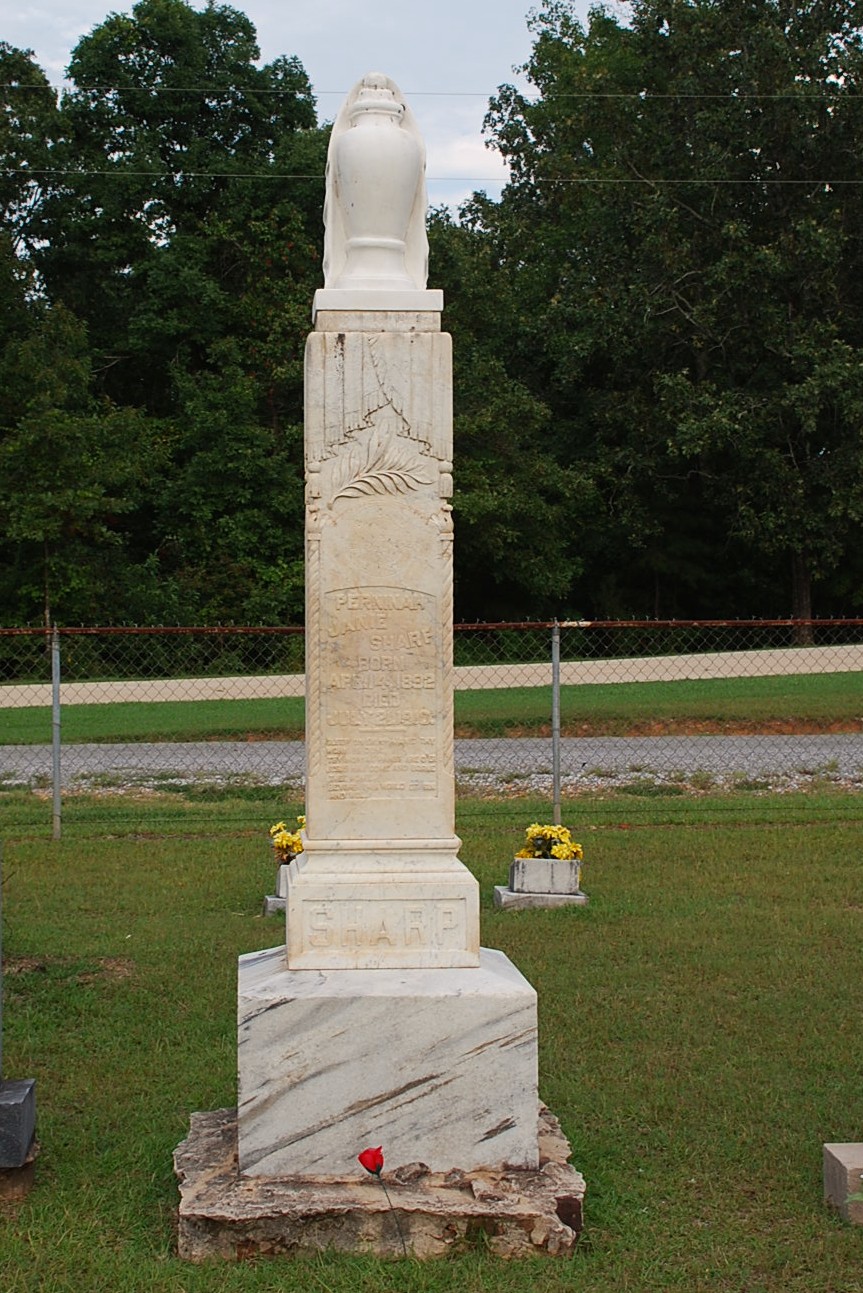
Janie Sharp's Tombstone
SwintonPermenter died on August 16, 1946 and is buried at the Mountain Home National Cemetery in Johnson City, Tennessee.

There are a great deal of details and mostly hearsay about this event that were not included in these articles; some because they were merely rumor, others because they may not have been pertinent as told. One interesting bit of information not previously included was a Winston County Journal article that indicated that a set of bloody clothes were found hidden under a fallen log, several months after the murder. It stated that the garments showed much decay and were to be brought to the sheriff's office for examination. After that article, no further mention of these garments were made. It is not known by this writer if they ever existed, or were never submitted to the sheriff, or were determined to not be pertinent to the case. In any event, they were never mentioned again.
I would be amiss if I didn't give credit to two compilations about the Janie Sharp event. THE TRIAL for the MURDER of PERNINAH JANIE SHARP by Lucille Wood and TRIAL OF SWINTON PERMENTER FOR THE MURDER OF MISS JANIE SHARP JULY 21,1910 by Ruby C. Hurt. Both of these books are available for sale at the Winston County Library and I encourage those who are interested to take a closer look at these compilations of news reports and trial transcripts. They contain more details and contradictory information.
Monday, September 6, 2010
Janie Sharp Series # 7 - After the Trial
Janie Sharp had been murdered while walking home along a wooded country lane on a hot August afternoon in 1910 near the backwoods community of Rural Hill, Mississippi. Suspicions fell immediately upon a young man, Swinton Permenter, not yet eighteen himself. A two year ordeal ensued that included a trial and conviction, a Supreme Court ruling that overturned the conviction, suspicions cast upon others, the murders of two men and a second trial that was a sensation across Mississippi and the South.
When the Mississippi dust settled, no one was brought to justice for Janie’s murder or those of Ben Walker, an investigator of the crime, or Walter Permenter, the brother of the suspect. To this day, no one can say who committed these crimes and anyone who may have had firsthand knowledge of the events of the day are long gone.
The Sharp’s were convinced of Swinton’s guilt and apparently made no further attempts to find any other suspects. The lack of closure in the case fueled debate, hard feelings and suspicion not only in Rural Hill but in much of Winston County. Almost everyone was a relation or a friend to one or both families. Speculations and accusations continued for many years after the crime and in some forms still exist today.
Up until the 1970’s, students in local schools were forbidden to write about the murder for fear of opening old wounds. I was recently contacted by one individual who stated that the only thing he had ever seen his grandparents argue over was the guilt or innocence of Swinton Permenter. Emotions ran high for many years and rumors of death threats surfaced often when someone began asking too many questions.
As a result, speculation turned to rumor, rumor intermingled with truth and the story became more sensational over the years. Soon, Janie became the subject of legend; a ghost story to tell around a campfire on a cool October evening or a cautionary tale for willful young girls. It seemed that each year the story became more gruesome, bloody and fantastic - and visiting Janie’s grave is now a favorite rite of passage for local high school kids on Halloween night; kids who know nothing about the real events of Janie’s death and the drama that followed.
The people of Rural Hill and Winston County went back to their farms and businesses and continued their lives. But what happened to the principal characters in this story?
The Permenter Family apparently stayed in Mississippi although at some point, they sold their property in Rural Hill. Records show that Swinton’s parents, Edward and Anna are buried in the Hopewell Baptist Cemetery in Choctaw County, Ms. Edward died in 1932 and Anna passed away in 1942. Swinton’s brothers and sisters stayed in Mississippi as well and at least one stayed in the immediate area.
Cyrus Ray (Janie’s Uncle) and his family stayed in the Rural Hill area and most of the family is buried in the church cemetery.
Edward Permenter was killed in 1912 in Eupora. His murder was never solved. He is buried at the Masonic Cemetery in Louisville, Ms. He left a widow (Madie or Maudie) and three children. She soon left Rural Hill and moved to Kemper county and then Philadelphia, Ms. where she raised her children. She died in 1969 and is buried next to her husband.
Hewlet or Hulet Ray, one of the two men accused by Ben Walker of the crime moved to Oklahoma sometime before WW1 where he registered for the draft. He and his wife raised five children and he lived to a ripe old age in Oklahoma and is buried there. Little is known about Thomas McElroy (also accused by Ben Walker) after the trial and it is assumed that he returned to his home in Texas.
Ben Walker was killed in 1912 in the home of Elbert Vowell in Winston County. His killer was never captured or identified. Nothing is known about his past and his body was never claimed by family members, He is buried in the Smallwood or Wood Cemetery in that area.
Earl Ray, the fiancé of Janie Sharp, married in 1914 and continued to live in Mississippi and the general area. He raised several children and passed away in Choctaw County in the 1960’s.
The Will Sharp family stayed in Rural Hill for a short while after the trial, but in 1913, they sold their property and most of the immediate family packed their belongings and moved to Bryan, Oklahoma. Much of the family still live in that area today. Janie’s Father, Will, passed away in 1919 and her Mother passed just one year later. They are buried in Calera, Oklahoma. The Sharp home in Rural Hill burned to the ground in 1921.
Swinton Permenter’s whereabouts immediately after the trial are not known. It is doubtful, that he ever returned to the Rural Hill area for any length of time. Much of the following information here is not verifiable but was accumulated from various sources. It is believed that he lived for a period of time in Okolona, Ms. He entered military service during WW1. Some have indicated that he initially enlisted under the false name, Jesse Jackson. If so, this was corrected as later military records indicate his real name. There is also some evidence that he lived and worked in the oil fields in Texas and Oklahoma for a period of time but he is listed in the 1930 census as a resident of Bolivar, County, Ms. and residing in the household of his younger sister. At sometime after 1930, he apparently married a woman from North Carolina. There is little information about the marriage and no indication of children. In his later years, Swinton apparently endured health problems and may have suffered paralysis in his legs and possibly his hands. As a result, he may have spent his last years in a V.A. home in Johnson City, Tennessee as this was listed as his last address. Swinton Permenter died on August 16, 1946 and is buried at the Mountain Home National Cemetery in Johnson City, Tennessee.
Janie Sharp lost her life on July 21, 1910. She is buried not at Rural Hill but in the Center Ridge Methodist Church Cemetery located several miles east of Rural Hill. This cemetery was probably chosen because her sister, an infant was previously buried here.
When the Mississippi dust settled, no one was brought to justice for Janie’s murder or those of Ben Walker, an investigator of the crime, or Walter Permenter, the brother of the suspect. To this day, no one can say who committed these crimes and anyone who may have had firsthand knowledge of the events of the day are long gone.
The Sharp’s were convinced of Swinton’s guilt and apparently made no further attempts to find any other suspects. The lack of closure in the case fueled debate, hard feelings and suspicion not only in Rural Hill but in much of Winston County. Almost everyone was a relation or a friend to one or both families. Speculations and accusations continued for many years after the crime and in some forms still exist today.
Up until the 1970’s, students in local schools were forbidden to write about the murder for fear of opening old wounds. I was recently contacted by one individual who stated that the only thing he had ever seen his grandparents argue over was the guilt or innocence of Swinton Permenter. Emotions ran high for many years and rumors of death threats surfaced often when someone began asking too many questions.
As a result, speculation turned to rumor, rumor intermingled with truth and the story became more sensational over the years. Soon, Janie became the subject of legend; a ghost story to tell around a campfire on a cool October evening or a cautionary tale for willful young girls. It seemed that each year the story became more gruesome, bloody and fantastic - and visiting Janie’s grave is now a favorite rite of passage for local high school kids on Halloween night; kids who know nothing about the real events of Janie’s death and the drama that followed.
The people of Rural Hill and Winston County went back to their farms and businesses and continued their lives. But what happened to the principal characters in this story?
The Permenter Family apparently stayed in Mississippi although at some point, they sold their property in Rural Hill. Records show that Swinton’s parents, Edward and Anna are buried in the Hopewell Baptist Cemetery in Choctaw County, Ms. Edward died in 1932 and Anna passed away in 1942. Swinton’s brothers and sisters stayed in Mississippi as well and at least one stayed in the immediate area.
Cyrus Ray (Janie’s Uncle) and his family stayed in the Rural Hill area and most of the family is buried in the church cemetery.
Edward Permenter was killed in 1912 in Eupora. His murder was never solved. He is buried at the Masonic Cemetery in Louisville, Ms. He left a widow (Madie or Maudie) and three children. She soon left Rural Hill and moved to Kemper county and then Philadelphia, Ms. where she raised her children. She died in 1969 and is buried next to her husband.
Hewlet or Hulet Ray, one of the two men accused by Ben Walker of the crime moved to Oklahoma sometime before WW1 where he registered for the draft. He and his wife raised five children and he lived to a ripe old age in Oklahoma and is buried there. Little is known about Thomas McElroy (also accused by Ben Walker) after the trial and it is assumed that he returned to his home in Texas.
Ben Walker was killed in 1912 in the home of Elbert Vowell in Winston County. His killer was never captured or identified. Nothing is known about his past and his body was never claimed by family members, He is buried in the Smallwood or Wood Cemetery in that area.
Earl Ray, the fiancé of Janie Sharp, married in 1914 and continued to live in Mississippi and the general area. He raised several children and passed away in Choctaw County in the 1960’s.
The Will Sharp family stayed in Rural Hill for a short while after the trial, but in 1913, they sold their property and most of the immediate family packed their belongings and moved to Bryan, Oklahoma. Much of the family still live in that area today. Janie’s Father, Will, passed away in 1919 and her Mother passed just one year later. They are buried in Calera, Oklahoma. The Sharp home in Rural Hill burned to the ground in 1921.
Swinton Permenter’s whereabouts immediately after the trial are not known. It is doubtful, that he ever returned to the Rural Hill area for any length of time. Much of the following information here is not verifiable but was accumulated from various sources. It is believed that he lived for a period of time in Okolona, Ms. He entered military service during WW1. Some have indicated that he initially enlisted under the false name, Jesse Jackson. If so, this was corrected as later military records indicate his real name. There is also some evidence that he lived and worked in the oil fields in Texas and Oklahoma for a period of time but he is listed in the 1930 census as a resident of Bolivar, County, Ms. and residing in the household of his younger sister. At sometime after 1930, he apparently married a woman from North Carolina. There is little information about the marriage and no indication of children. In his later years, Swinton apparently endured health problems and may have suffered paralysis in his legs and possibly his hands. As a result, he may have spent his last years in a V.A. home in Johnson City, Tennessee as this was listed as his last address. Swinton Permenter died on August 16, 1946 and is buried at the Mountain Home National Cemetery in Johnson City, Tennessee.
Janie Sharp lost her life on July 21, 1910. She is buried not at Rural Hill but in the Center Ridge Methodist Church Cemetery located several miles east of Rural Hill. This cemetery was probably chosen because her sister, an infant was previously buried here.
Thursday, September 2, 2010
Janie Sharp Series Continues # 6 - The Verdict
This two year drama began on a county road near Rural Hill, Mississippi in 1910 with the brutal murder of an attractive young woman ready to start her adult life. It was about to culminate in a packed, sweltering courtroom in the small town of Winona; a courtroom where the fate of another young person was to be decided – freedom or death at the end of a noose. Through these two years, a whole county was divided. Feelings ran high and even families were torn between their support of the victim’s family and the belief in the innocence of a young man named Swinton Permenter.
The Sharp family never wavered in their belief in Swinton’s guilt. The Permenter family likewise rallied to their youngest son, resolute in their certainty of his innocence. These two years also saw the blatant murders of two men; murders that were almost certainly tied to the case- and murders in which no one was ever brought to justice. The killers of Ben Walker and Walter Permenter were never found, no one was ever indicted for either of these crimes and these tragic murders simply faded into history.
Both sides had presented their cases, evidence was produced, rebuttals made and lengthy summations presented. It was now all in the hands of a jury of twelve men. It was late afternoon before deliberations began and at 8:00 pm, the jury retired for the night without a verdict. The crowd, the press and the defendant would have to wait for morning. By 8:30 am the next day, the jury was ready to deliver their decision to a packed courtroom. They filed into the jury box and the judge asked if they had reached a verdict. The jury foreman replied, “Yes sir, we have.” The verdict was passed to the clerk as dead silence fell upon the crowded courtroom.
“We the jury, find the defendant NOT GUILTY.”
There was no outburst in the courtroom, no gasp of despair or relief, only a low, almost inaudible murmur. The defendant sat speechless as the judge thanked the jury, the attorneys and the local community. The foreman stood and thanked the sheriff and the court for the courtesy and kindness shown to the jury throughout the trial.
As the court was adjourned, the Permenter family rose and rushed to the jury to shake hands and thank them. Swinton’s Father spoke, “ Thank God, My poor boy is free! He never killed that girl.”.
In an action that would be considered unusual today, Swinton was shortly able to address the jury as they assembled one last time in the jury room. In the presence of his family, he was able to thank the twelve men for their kindness and his acquittal.
The Sharp family’s actions were decidedly different. Janie’s Father was quoted, “It’s a crying shame that such a result could have been reached. Nobody in the world but Permenter killed my daughter and if they were to bring in another man charged with the crime, I’d say nobody but Swinton Permenter murdered her.” Lee Sharp, Jannie's brother, warned about the danger of turning such a heartless brute loose in any community.
Regardless, Swinton Permenter was a free man. Due to the emotion of the Sharp family and friends, Swinton was guarded throughout that day until he left Winona that evening. His
destination was closely guarded; all that was disclosed – "headed to some point not known. "
The Sharp’s and Permenter’s returned to their homes in Rural Hill that evening by train. Some evidence suggests that both families took the same train. The Sharps were met at the McCool depot by a large crowd who expressed their sympathy due to the outcome of the case.
One of the most sensational trials in Mississippi history was over yet there was no resolution to Janie Sharp’s murder; no justice, no punishment, no sense of closure for her family or for the communities of Rural Hill, Louisville and Winston County. The trial may have been over, but the story was not.
W. McCully
The Sharp family never wavered in their belief in Swinton’s guilt. The Permenter family likewise rallied to their youngest son, resolute in their certainty of his innocence. These two years also saw the blatant murders of two men; murders that were almost certainly tied to the case- and murders in which no one was ever brought to justice. The killers of Ben Walker and Walter Permenter were never found, no one was ever indicted for either of these crimes and these tragic murders simply faded into history.
Both sides had presented their cases, evidence was produced, rebuttals made and lengthy summations presented. It was now all in the hands of a jury of twelve men. It was late afternoon before deliberations began and at 8:00 pm, the jury retired for the night without a verdict. The crowd, the press and the defendant would have to wait for morning. By 8:30 am the next day, the jury was ready to deliver their decision to a packed courtroom. They filed into the jury box and the judge asked if they had reached a verdict. The jury foreman replied, “Yes sir, we have.” The verdict was passed to the clerk as dead silence fell upon the crowded courtroom.
“We the jury, find the defendant NOT GUILTY.”
There was no outburst in the courtroom, no gasp of despair or relief, only a low, almost inaudible murmur. The defendant sat speechless as the judge thanked the jury, the attorneys and the local community. The foreman stood and thanked the sheriff and the court for the courtesy and kindness shown to the jury throughout the trial.
As the court was adjourned, the Permenter family rose and rushed to the jury to shake hands and thank them. Swinton’s Father spoke, “ Thank God, My poor boy is free! He never killed that girl.”.
In an action that would be considered unusual today, Swinton was shortly able to address the jury as they assembled one last time in the jury room. In the presence of his family, he was able to thank the twelve men for their kindness and his acquittal.
The Sharp family’s actions were decidedly different. Janie’s Father was quoted, “It’s a crying shame that such a result could have been reached. Nobody in the world but Permenter killed my daughter and if they were to bring in another man charged with the crime, I’d say nobody but Swinton Permenter murdered her.” Lee Sharp, Jannie's brother, warned about the danger of turning such a heartless brute loose in any community.
Regardless, Swinton Permenter was a free man. Due to the emotion of the Sharp family and friends, Swinton was guarded throughout that day until he left Winona that evening. His
destination was closely guarded; all that was disclosed – "headed to some point not known. "
The Sharp’s and Permenter’s returned to their homes in Rural Hill that evening by train. Some evidence suggests that both families took the same train. The Sharps were met at the McCool depot by a large crowd who expressed their sympathy due to the outcome of the case.
One of the most sensational trials in Mississippi history was over yet there was no resolution to Janie Sharp’s murder; no justice, no punishment, no sense of closure for her family or for the communities of Rural Hill, Louisville and Winston County. The trial may have been over, but the story was not.
W. McCully
Sunday, August 29, 2010
Janie Sharp Article #5 The Final Trial
The Second Trial
This is the 5th in a series of articles about the 1910 murder of Janie Sharp in Winston County, Ms. Due to the length of the actual trial, this article is somewhat longer than the previous four.
It had been more than 2 years since Janie Sharp's murder and it had been months since Investigator Ben Walker had died in a hail of buckshot. Now just three days before the start of the second trial of Swinton Permenter for Janie's death, Walter Permenter, Swinton's brother, had also been killed by an unknown assailant. A delay was inevitable but it would be a short one. On August 12th, 1912 - just one week after the original trial date, a crowd packed into a courtroom in Winona, Ms. for one of the most celebrated legal battles in Mississippi history. It was August and the heat was stifling but people came from all over the state to see the proceedings. The courtroom even contained a few women which was unusual at the time. Law enforcement was out in force and everyone entering the courtroom was searched.
The jury selection took the better part of two days and jurors were selected from a pool of 100. Both the prosecution and the defense were represented by a large team of attorneys including former judges and a former congressman. Before it was over, the prosecution would present 25 witnesses and the defense would bring 20 to the stand including the defendant during the twelve day trial.
The prosecution's case was not significantly different than the one it presented during the first trial in Louisville contending that Swinton Permenter encountered Janie on the Commodore Road, forced her into the woods where he attacked and brutally murdered her. The defense's strategy was to cast doubt upon some of the evidence and testimony presented and to provide alternatives to Swinton as the killer.
The trial started with Janie's Mother as the first witness for the prosecution. Much of her testimony surrounded the identification of the handkerchief in question. She testified that the handkerchief was a gift from Janie's Grandmother. After close visual inspection, she identified the handkerchief found in Permenter's possession as the one that belonged to Janie indicating a slight tear and some particular stitching. This handkerchief was key to the whole trial. If the jury believed that it belonged to Janie, it would leave little doubt of Permenter’s guilt. Mrs. Sharp also testified that there had been no bad feelings between her family & the Permenters and that there was no “courting relationship” between Janie & Swinton.
Several witnesses testified concerning Janie’s presence at the general store in Rural Hill the day of the murder. There was basic agreement as to the time she left (3:00pm) and the items in her possession at that time.
The next day’s testimony started in a similar manner. Claud Massey testified that he met Janie on the Commodore Road in that general time frame. He denied meeting anyone else on the road and he specifically denied seeing Hewlet Ray and Tom McElroy (the two men accused by Detective Ben Walker) when questioned by the defense.
Lee Sharp was the next major witness to testify .His testimony and cross examination took more than five hours. In great detail, he described the search for his sister, and Permenter’s behavior during this time including carrying a pistol in his pocket, his discouragement of others in searching the very area where Janie’s body was later found, and his percieved attempt to lead them in another direction. He then told of finding his sister’s body about a quarter of a mile from the Permenter home in a branch, partially submerged. He noticed that her throat was cut half way around and that she had a bruise on her head that he believed was done by the butt of a pistol. He told of later returning to the area and noticing signs of a scuffle in several places and tracks that appeared to be that of a man and a woman, all roughly within a hundred yards of where Janie’s body was found. He later described the clothes worn by Swinton Permenter during the search (suit of blue serge) and his arrest later that morning.
Lee Sharp’s testimony led to another key point in the trial. After Permenter came under suspicion, the shoes he was wearing after he changed clothes were compared to some of the tracks near the crime scene. It was determined at that time that the shoe matched the tracks. In the trial these were called “low quarter shoes” and were identified by Lee Sharp as the ones worn by Permenter on the night of the search. The defense then produced another set of shoes that were referred to as “high quarter shoes”. The defense claimed that these were the shoes worn by Permenter until he changed clothes the next morning when he replaced them with the low quarter shoes. To bolster their claim the defense called former sheriff A.P. Hull and his deputy W.R. Hull. Both identified the high quarter shoes as those found with Permenter’s clothes and that they were wet when they took possession of them. When compared to a witch-hazel stick used to measure the track at the time of murder, the shoes did not correspond to the measure. This cast significant doubt on the validity of any track & shoe evidence that might have been used in the first trial.
The state presented an array of witnesses concerning the night of the search and Permenter's behavior and location. These included Hewlett Ray and Tom McElroy who also denied any involvement in the murder. Several witnesses testified to statements made by Swinton concerning his desire for Janie and his dislike of her Father because he refused to allow him to court Janie.
Also included was testimony by J.T. Hanna whose bloodhound trailed to the Permenter home and ultimately to Swinton. More witnesses spoke of Swinton's remarks that the dogs would surely track him because of his presence in the woods while searching for Janie.
Terrell Hall's testimony was read into the record as he was not present at the trial. His evidence was that he was with Swinton when he went home to change clothes and wash. He indicated that the clothes were later found in a side room of the home and included a barlow knife, tobacco and two handkerchiefs - one of which was a woman's.
After a parade of witnesses the prosecution rested its case. The defense used this as an opportunity to make a motion for dismissal. This was, of course, denied and the defense began to present its case.
****
Most of the defense's first witnesses concerned the time frame of the murder and their testimony seemed to indicate that Swinton would have had little time to commit the act. Those who had been swimming earlier in the day with Permenter indicated that they left together at about 2:35 pm. Alonzo Burchfield testified that he was with Swinton at about 3:20 when they stopped to draw water at the Permenter house before returning to the fields to plow. He indicated that he last saw Permenter headed to the field at about 3:30. Permenter's sister testified that she saw Swinton at about 3:45. If these times were accurate, it would have been highly unlikely that Swinton Permenter would have had sufficient time to commit the murder.
The prosecution presented some rebuttal witnesses that called the defense's time line into question but there was no definitive resolution of the issue.
The defense then moved to the question of the handkerchief. It was never denied that a lady's handkerchief was in Swinton's possession, but there was an explanation. Swinton's sister, Nellie, testified that on the 4th of July previous to the murder, at a picnic at Indian Springs, several young people including Janie Sharp were sitting in various buggies. She remembered Janie and a young man named Fletcher Whitney (or Whitmire) were sitting in her brother Walter's (now deceased) buggy. She testified that at some time later, Walter handed her a handkerchief that he had picked up in his buggy after the picnic and told her to tell Swinton to find its owner. It was the defense's claim that Swinton never did so and that was why it was still in his possession. At this point,the defense counsel produced another handkerchief. Nellie compared the two and indicated that they were identical. Both handkerchiefs were handed to the jury for comparison. It was apparent that the defense wanted to contradict previous testimony that the handkerchief found in Permenter's possession was unique and identifiable as Janie's.
The next witness was J.L. Wilson who testified that as Janie's body was being prepared for burial at her home, he saw next to the corpse, not only her parasol and her bundles from the store but also a lady's handkerchief. He indicated that one of the women present identified it as Janie's and the same one that she had change tied up in at the store that day. When questioned by the prosecution, Wilson indicated that several others had heard the remark but could not specifically identify anyone else who could corroborate it. The prosecution made a point of identifying Wilson as a farmer who rented land from the Permenter family.
The defense next addressed the rumor of an eyewitness to the crime. Rumors had circulated that Swinton's cousin, Effie Permenter who had since married Henry Ray, had actually seen Swinton murder Janie as she was washing clothes near her home. Rumors also persisted that Lee Sharp had offered Effie's husband $100 if she would come forward. Effie testified in the case and denied any knowledge of the murder. Lee Sharp was also recalled and he denied making the offer but he did believe that Effie knew all about the murder.
Several more witnesses were presented by the defense concerning times that Swinton was seen throughout that afternoon. Now it was time for the defendant to testify. Swinton Permenter took the stand on the morning of August 20th. He indicated that he had known Janie Sharp all his life, had kept company with her several times but other girls as well. He testified that on the day of the murder, he plowed until 11:30 am, went to the Heinze Post Office to give the Postmaster money to order four quarts of sherry wine. He then went to the swimming hole with several companions. The distance from there to the Sharp residence was 3.5 miles. He claimed to have left the swimming hole with his companions at 2:36 and parted company with Lon Burchfield at around 3:20 to 3:30 where he went directly to the field and resumed his plowing. He indicated that he changed plow horses with his Father during that time and that he finished plowing at sundown. When he reached home, the phone rang and the news of Janie’s disappearance was reported. Swinton denied certain statements attributed to him about his desires for Janie, and he denied trying to mislead the search party. He also denied that the bloodhound used that night specifically scented him. He said that after Janie’s body was found, he went home to change because his clothes were wet from a light rain during the night. He explained that the woman’s handkerchief in his pocket was the one found by his brother Walter on July the Fourth and that he had simply stuck the handkerchief in his coat pocket and forgotten about it. The prosecution set the crowd abuzz when Swinton was asked if he had ever been fined or indicted for assaulting a little girl. Swinton denied both and said that he had never been convicted in a justice or circuit court. The prosecution apparently did not follow up on this question.
The defense presented several other witnesses, including Swinton’s parents who corroborated his testimony. J.P. McAllilley a former justice of the peace, had observed the location of Janie’s body at that time and noted that there was very little blood at the spot and that there was no evidence of a struggle, creating the idea that Janie’s body may have been moved from where she was actually killed.
The defense rested their case and the state presented several rebuttal witnesses. These witnesses disputed the time line presented by several defense witnesses and some hearsay evidence of rumors and conversations about the veracity of certain witnesses, conflicts of the timeline presented by the defense and statements made by Permenter were presented. After several back and forth rebuttal witnesses, the case went to closing arguments.
On August 22, arguments for the defense and prosecution were scheduled to begin. The already large crowd continued to swell. The gallery was reserved for women only and it was packed. People had come from all over the state including many attorneys who came specifically to hear the closing arguments. Extra deputies were stationed around the courtroom adding to the already tight security. The defendant’s family sat on one side of the courtroom while the Sharp’s sat on the other. That morning brought much legal wrangling over the instructions to the jury and it was afternoon before closing arguments began. Seven different attorneys addressed the jury and these closing arguments took as much as ten hours continuing into the next day. It was 3:30 in the afternoon before the jury actually got the case. At 8 o’clock that evening they retired for the night without a verdict. The fate of Swinton Permenter would be decided the next day on August 24, more than two years after Janie Sharp’s murder.
W. McCully
This is the 5th in a series of articles about the 1910 murder of Janie Sharp in Winston County, Ms. Due to the length of the actual trial, this article is somewhat longer than the previous four.
It had been more than 2 years since Janie Sharp's murder and it had been months since Investigator Ben Walker had died in a hail of buckshot. Now just three days before the start of the second trial of Swinton Permenter for Janie's death, Walter Permenter, Swinton's brother, had also been killed by an unknown assailant. A delay was inevitable but it would be a short one. On August 12th, 1912 - just one week after the original trial date, a crowd packed into a courtroom in Winona, Ms. for one of the most celebrated legal battles in Mississippi history. It was August and the heat was stifling but people came from all over the state to see the proceedings. The courtroom even contained a few women which was unusual at the time. Law enforcement was out in force and everyone entering the courtroom was searched.
The jury selection took the better part of two days and jurors were selected from a pool of 100. Both the prosecution and the defense were represented by a large team of attorneys including former judges and a former congressman. Before it was over, the prosecution would present 25 witnesses and the defense would bring 20 to the stand including the defendant during the twelve day trial.
The prosecution's case was not significantly different than the one it presented during the first trial in Louisville contending that Swinton Permenter encountered Janie on the Commodore Road, forced her into the woods where he attacked and brutally murdered her. The defense's strategy was to cast doubt upon some of the evidence and testimony presented and to provide alternatives to Swinton as the killer.
The trial started with Janie's Mother as the first witness for the prosecution. Much of her testimony surrounded the identification of the handkerchief in question. She testified that the handkerchief was a gift from Janie's Grandmother. After close visual inspection, she identified the handkerchief found in Permenter's possession as the one that belonged to Janie indicating a slight tear and some particular stitching. This handkerchief was key to the whole trial. If the jury believed that it belonged to Janie, it would leave little doubt of Permenter’s guilt. Mrs. Sharp also testified that there had been no bad feelings between her family & the Permenters and that there was no “courting relationship” between Janie & Swinton.
Several witnesses testified concerning Janie’s presence at the general store in Rural Hill the day of the murder. There was basic agreement as to the time she left (3:00pm) and the items in her possession at that time.
The next day’s testimony started in a similar manner. Claud Massey testified that he met Janie on the Commodore Road in that general time frame. He denied meeting anyone else on the road and he specifically denied seeing Hewlet Ray and Tom McElroy (the two men accused by Detective Ben Walker) when questioned by the defense.
Lee Sharp was the next major witness to testify .His testimony and cross examination took more than five hours. In great detail, he described the search for his sister, and Permenter’s behavior during this time including carrying a pistol in his pocket, his discouragement of others in searching the very area where Janie’s body was later found, and his percieved attempt to lead them in another direction. He then told of finding his sister’s body about a quarter of a mile from the Permenter home in a branch, partially submerged. He noticed that her throat was cut half way around and that she had a bruise on her head that he believed was done by the butt of a pistol. He told of later returning to the area and noticing signs of a scuffle in several places and tracks that appeared to be that of a man and a woman, all roughly within a hundred yards of where Janie’s body was found. He later described the clothes worn by Swinton Permenter during the search (suit of blue serge) and his arrest later that morning.
Lee Sharp’s testimony led to another key point in the trial. After Permenter came under suspicion, the shoes he was wearing after he changed clothes were compared to some of the tracks near the crime scene. It was determined at that time that the shoe matched the tracks. In the trial these were called “low quarter shoes” and were identified by Lee Sharp as the ones worn by Permenter on the night of the search. The defense then produced another set of shoes that were referred to as “high quarter shoes”. The defense claimed that these were the shoes worn by Permenter until he changed clothes the next morning when he replaced them with the low quarter shoes. To bolster their claim the defense called former sheriff A.P. Hull and his deputy W.R. Hull. Both identified the high quarter shoes as those found with Permenter’s clothes and that they were wet when they took possession of them. When compared to a witch-hazel stick used to measure the track at the time of murder, the shoes did not correspond to the measure. This cast significant doubt on the validity of any track & shoe evidence that might have been used in the first trial.
The state presented an array of witnesses concerning the night of the search and Permenter's behavior and location. These included Hewlett Ray and Tom McElroy who also denied any involvement in the murder. Several witnesses testified to statements made by Swinton concerning his desire for Janie and his dislike of her Father because he refused to allow him to court Janie.
Also included was testimony by J.T. Hanna whose bloodhound trailed to the Permenter home and ultimately to Swinton. More witnesses spoke of Swinton's remarks that the dogs would surely track him because of his presence in the woods while searching for Janie.
Terrell Hall's testimony was read into the record as he was not present at the trial. His evidence was that he was with Swinton when he went home to change clothes and wash. He indicated that the clothes were later found in a side room of the home and included a barlow knife, tobacco and two handkerchiefs - one of which was a woman's.
After a parade of witnesses the prosecution rested its case. The defense used this as an opportunity to make a motion for dismissal. This was, of course, denied and the defense began to present its case.
****
Most of the defense's first witnesses concerned the time frame of the murder and their testimony seemed to indicate that Swinton would have had little time to commit the act. Those who had been swimming earlier in the day with Permenter indicated that they left together at about 2:35 pm. Alonzo Burchfield testified that he was with Swinton at about 3:20 when they stopped to draw water at the Permenter house before returning to the fields to plow. He indicated that he last saw Permenter headed to the field at about 3:30. Permenter's sister testified that she saw Swinton at about 3:45. If these times were accurate, it would have been highly unlikely that Swinton Permenter would have had sufficient time to commit the murder.
The prosecution presented some rebuttal witnesses that called the defense's time line into question but there was no definitive resolution of the issue.
The defense then moved to the question of the handkerchief. It was never denied that a lady's handkerchief was in Swinton's possession, but there was an explanation. Swinton's sister, Nellie, testified that on the 4th of July previous to the murder, at a picnic at Indian Springs, several young people including Janie Sharp were sitting in various buggies. She remembered Janie and a young man named Fletcher Whitney (or Whitmire) were sitting in her brother Walter's (now deceased) buggy. She testified that at some time later, Walter handed her a handkerchief that he had picked up in his buggy after the picnic and told her to tell Swinton to find its owner. It was the defense's claim that Swinton never did so and that was why it was still in his possession. At this point,the defense counsel produced another handkerchief. Nellie compared the two and indicated that they were identical. Both handkerchiefs were handed to the jury for comparison. It was apparent that the defense wanted to contradict previous testimony that the handkerchief found in Permenter's possession was unique and identifiable as Janie's.
The next witness was J.L. Wilson who testified that as Janie's body was being prepared for burial at her home, he saw next to the corpse, not only her parasol and her bundles from the store but also a lady's handkerchief. He indicated that one of the women present identified it as Janie's and the same one that she had change tied up in at the store that day. When questioned by the prosecution, Wilson indicated that several others had heard the remark but could not specifically identify anyone else who could corroborate it. The prosecution made a point of identifying Wilson as a farmer who rented land from the Permenter family.
The defense next addressed the rumor of an eyewitness to the crime. Rumors had circulated that Swinton's cousin, Effie Permenter who had since married Henry Ray, had actually seen Swinton murder Janie as she was washing clothes near her home. Rumors also persisted that Lee Sharp had offered Effie's husband $100 if she would come forward. Effie testified in the case and denied any knowledge of the murder. Lee Sharp was also recalled and he denied making the offer but he did believe that Effie knew all about the murder.
Several more witnesses were presented by the defense concerning times that Swinton was seen throughout that afternoon. Now it was time for the defendant to testify. Swinton Permenter took the stand on the morning of August 20th. He indicated that he had known Janie Sharp all his life, had kept company with her several times but other girls as well. He testified that on the day of the murder, he plowed until 11:30 am, went to the Heinze Post Office to give the Postmaster money to order four quarts of sherry wine. He then went to the swimming hole with several companions. The distance from there to the Sharp residence was 3.5 miles. He claimed to have left the swimming hole with his companions at 2:36 and parted company with Lon Burchfield at around 3:20 to 3:30 where he went directly to the field and resumed his plowing. He indicated that he changed plow horses with his Father during that time and that he finished plowing at sundown. When he reached home, the phone rang and the news of Janie’s disappearance was reported. Swinton denied certain statements attributed to him about his desires for Janie, and he denied trying to mislead the search party. He also denied that the bloodhound used that night specifically scented him. He said that after Janie’s body was found, he went home to change because his clothes were wet from a light rain during the night. He explained that the woman’s handkerchief in his pocket was the one found by his brother Walter on July the Fourth and that he had simply stuck the handkerchief in his coat pocket and forgotten about it. The prosecution set the crowd abuzz when Swinton was asked if he had ever been fined or indicted for assaulting a little girl. Swinton denied both and said that he had never been convicted in a justice or circuit court. The prosecution apparently did not follow up on this question.
The defense presented several other witnesses, including Swinton’s parents who corroborated his testimony. J.P. McAllilley a former justice of the peace, had observed the location of Janie’s body at that time and noted that there was very little blood at the spot and that there was no evidence of a struggle, creating the idea that Janie’s body may have been moved from where she was actually killed.
The defense rested their case and the state presented several rebuttal witnesses. These witnesses disputed the time line presented by several defense witnesses and some hearsay evidence of rumors and conversations about the veracity of certain witnesses, conflicts of the timeline presented by the defense and statements made by Permenter were presented. After several back and forth rebuttal witnesses, the case went to closing arguments.
On August 22, arguments for the defense and prosecution were scheduled to begin. The already large crowd continued to swell. The gallery was reserved for women only and it was packed. People had come from all over the state including many attorneys who came specifically to hear the closing arguments. Extra deputies were stationed around the courtroom adding to the already tight security. The defendant’s family sat on one side of the courtroom while the Sharp’s sat on the other. That morning brought much legal wrangling over the instructions to the jury and it was afternoon before closing arguments began. Seven different attorneys addressed the jury and these closing arguments took as much as ten hours continuing into the next day. It was 3:30 in the afternoon before the jury actually got the case. At 8 o’clock that evening they retired for the night without a verdict. The fate of Swinton Permenter would be decided the next day on August 24, more than two years after Janie Sharp’s murder.
W. McCully
Wednesday, August 25, 2010
Janie Sharp Series #4- Shotgun- Weapon of Choice
This is the 4th in the series of articles in the Janie Sharp series. To this point, after Janie's murder, the young man Swinton Permenter was accused, tried and convicted of the crime. The State Supreme Court threw out the verdict and a new trial was scheduled but it would be more than a year from his release before the final trial began. In that year, events seemed to spiral out of control.
Between the Trials
Little is known about Ben Walker. His qualifications as an investigator, exactly where he came from and how he became involved in the Janie Sharp affair are unclear, but his short role in the case was mysterious, confounding and tragic.
Some records (Commercial Appeal) indicate that Ben Walker testified in the first Permenter trial. If accurate, in his testimony he claimed to be from Cleveland, Ms. and was "instructed" by the Governor to make inquiries into the crime. The newspaper story indicated that Walker's testimony was inconsequential and that he left a poor impression upon the court.
Most accounts indicate that Walker was actually hired by the Permenter family. He possibly misrepresented himself under oath about his official status or he was later hired by the family in a non-official capacity.
In November, 1911, a little over a year after the first trial, Detective Ben Walker created a stir in the community when he returned from Greenville, Texas with Thomas McElroy and his family. Walker "arrested" McElroy for the murder of Janie Sharp.
McElroy was a previous resident of Rural Hill and strangely enough, a son-in-law to Cyrus Ray ( the uncle and neighbor of Janie & her fiancee). He and his family had moved to Texas in September ,1910 after Janie's murder. No suspicion had been cast upon McElroy prior to this time and his arrest by Walker was met with a great deal of skepticism.
A preliminary hearing was quickly scheduled and then delayed for a few days as a second suspect, Hulett Ray, was arrested upon an affidavit of Elbert Vowell. When the hearing took place in late November, the County Attorney, J. B. Gully quickly asked that all charges be dropped and stated that there was no evidence that these two men were involved in Janie Sharp's murder. McElroy & Ray were released and almost immediately, Ben Walker was arrested and charged with attempting to bribe witnesses. Walker claimed that his witnesses were intimidated and afraid to testify. As a result of the bribery charges, his already questionable reputation was further damaged and it certainly increased animosity toward him and his actions. No records indicate if these bribery charges were pursued or later dropped.
Walker remained in the area and it was assumed that he continued to work on the case, although he may have pursued other activities as well. While in the area, he stayed in the home of Elbert Vowell. (who had filed the affidavit against Hulett Ray). On the evening of March 21, , Walker was reading by lamplight in the Vowell home when a shotgun blast shattered the nearby window. Walker was struck in the head by buck shot and fell dead immediately. Vowell quickly grabbed a weapon and exchanged fire with two men leaving the house on horseback. No one else was wounded and no suspects were ever named in the death of Detective Ben Walker. He was buried in the Wood (Smallwood) Cemetery.
***
The second trial of Swinton Permenter was scheduled for early August,1912. The publicity and the threats that permeated the first trial led to a change of venue to Winona, Ms. about 45 miles northwest of Louisville. As the defense prepared their case, Swinton Permenter's brother Walter had become highly involved and some said that he had information gathered by Ben Walker that was material to the defense.
On Friday, August 2, 1912, Walter Permenter joined his brother Swinton at the home of Eugene Shewmake (possibly Shumaker) in the town of Eupora. Shewmake was apparently a brother-in-law to the Permenters. The brothers intended to leave Eupora on the next day and arrive at Winona where the trial was to begin on the following Monday.
Around nine o'clock, Swinton retired for the night. A short while later, Walter took a bucket outside to the back porch for some water. As he was drawing the water, he was struck by a shotgun blast. He was hit in the head, neck and chest, fell off the porch and quickly expired. Shewmake doused all the lights in the home fearing more shots from the assailant. Neighbors quickly appeared and rushed to the scene. The only witness was a young man who saw a single individual running across a vacant lot away from the Shewmake house just moments after the shot was fired.
The next day, bloodhounds were brought to the scene and soon picked up a trail that led southward around a cotton house at the local gin and further south into the Big Black Swamp. The dogs eventually lost the trail in the hills south of town. The next day, a young boy stumbled upon a shotgun hidden in the cotton house; a shotgun with one spent shell and several others loaded with buckshot.
Edward Walter Permenter had not lived to see his 31st birthday. He left a wife and three children. His remains were returned to Winston County and he was buried in the Masonic Cemetery in Louisville. No one was ever charged in his death. Some speculated that in the darkness,Walter was mistaken for Swinton while others claimed that Walter was actually the target because of information he might disclose at the upcoming trial.
It had been more than two years since Janie Sharp's murder. Now, there were two more unsolved murders of people associated with the case.
Between the Trials
Little is known about Ben Walker. His qualifications as an investigator, exactly where he came from and how he became involved in the Janie Sharp affair are unclear, but his short role in the case was mysterious, confounding and tragic.
Some records (Commercial Appeal) indicate that Ben Walker testified in the first Permenter trial. If accurate, in his testimony he claimed to be from Cleveland, Ms. and was "instructed" by the Governor to make inquiries into the crime. The newspaper story indicated that Walker's testimony was inconsequential and that he left a poor impression upon the court.
Most accounts indicate that Walker was actually hired by the Permenter family. He possibly misrepresented himself under oath about his official status or he was later hired by the family in a non-official capacity.
In November, 1911, a little over a year after the first trial, Detective Ben Walker created a stir in the community when he returned from Greenville, Texas with Thomas McElroy and his family. Walker "arrested" McElroy for the murder of Janie Sharp.
McElroy was a previous resident of Rural Hill and strangely enough, a son-in-law to Cyrus Ray ( the uncle and neighbor of Janie & her fiancee). He and his family had moved to Texas in September ,1910 after Janie's murder. No suspicion had been cast upon McElroy prior to this time and his arrest by Walker was met with a great deal of skepticism.
A preliminary hearing was quickly scheduled and then delayed for a few days as a second suspect, Hulett Ray, was arrested upon an affidavit of Elbert Vowell. When the hearing took place in late November, the County Attorney, J. B. Gully quickly asked that all charges be dropped and stated that there was no evidence that these two men were involved in Janie Sharp's murder. McElroy & Ray were released and almost immediately, Ben Walker was arrested and charged with attempting to bribe witnesses. Walker claimed that his witnesses were intimidated and afraid to testify. As a result of the bribery charges, his already questionable reputation was further damaged and it certainly increased animosity toward him and his actions. No records indicate if these bribery charges were pursued or later dropped.
Walker remained in the area and it was assumed that he continued to work on the case, although he may have pursued other activities as well. While in the area, he stayed in the home of Elbert Vowell. (who had filed the affidavit against Hulett Ray). On the evening of March 21, , Walker was reading by lamplight in the Vowell home when a shotgun blast shattered the nearby window. Walker was struck in the head by buck shot and fell dead immediately. Vowell quickly grabbed a weapon and exchanged fire with two men leaving the house on horseback. No one else was wounded and no suspects were ever named in the death of Detective Ben Walker. He was buried in the Wood (Smallwood) Cemetery.
***
The second trial of Swinton Permenter was scheduled for early August,1912. The publicity and the threats that permeated the first trial led to a change of venue to Winona, Ms. about 45 miles northwest of Louisville. As the defense prepared their case, Swinton Permenter's brother Walter had become highly involved and some said that he had information gathered by Ben Walker that was material to the defense.
On Friday, August 2, 1912, Walter Permenter joined his brother Swinton at the home of Eugene Shewmake (possibly Shumaker) in the town of Eupora. Shewmake was apparently a brother-in-law to the Permenters. The brothers intended to leave Eupora on the next day and arrive at Winona where the trial was to begin on the following Monday.
Around nine o'clock, Swinton retired for the night. A short while later, Walter took a bucket outside to the back porch for some water. As he was drawing the water, he was struck by a shotgun blast. He was hit in the head, neck and chest, fell off the porch and quickly expired. Shewmake doused all the lights in the home fearing more shots from the assailant. Neighbors quickly appeared and rushed to the scene. The only witness was a young man who saw a single individual running across a vacant lot away from the Shewmake house just moments after the shot was fired.
The next day, bloodhounds were brought to the scene and soon picked up a trail that led southward around a cotton house at the local gin and further south into the Big Black Swamp. The dogs eventually lost the trail in the hills south of town. The next day, a young boy stumbled upon a shotgun hidden in the cotton house; a shotgun with one spent shell and several others loaded with buckshot.
Edward Walter Permenter had not lived to see his 31st birthday. He left a wife and three children. His remains were returned to Winston County and he was buried in the Masonic Cemetery in Louisville. No one was ever charged in his death. Some speculated that in the darkness,Walter was mistaken for Swinton while others claimed that Walter was actually the target because of information he might disclose at the upcoming trial.
It had been more than two years since Janie Sharp's murder. Now, there were two more unsolved murders of people associated with the case.
Monday, August 23, 2010
Janie Sharp Series Continues #3 - The First Trial
This is the third in a series of articles about the murder of Janie Sharp in rural Winston County in 1910. For more details about the series, scroll down this page to the first article. This article concerns the first trial of the only person indicted in her death.
The First Trial
Charges were brought against Swinton Permenter for the brutal murder of Janie Sharp. The two other individuals brought in for questioning were released and the authorities believed they had their man. A significant amount of circumstantial evidence existed:
A handkerchief believed to be the victim's in Permenter's possession.
A reasonable match of shoe size to some of the tracks found near the murder area.
His proximity to the area and time of the crime.
The bloodhound's tracking of Permenter to his family's home.
His strange and, at least to some, misleading behavior during the search for Janie.
There were rumors also. Some claimed that Swinton Permenter made some remarks indicating his desire for Janie's affection and that he had made some vague threats against Janie's Father, possibly because he prevented Permenter from pursuing Janie.
This circumstantial evidence against this young man was significant - If it was accurate.
Contrary to modern day criminal trials, things advanced quickly. The trial was set in Louisville in early October, 1910. The case was heard before Judge McLean with prosecutors,Lamb, Gully and Jones and defense attorneys, Rodgers, Brantley, and Hopkins.
The Winston County Journal made much of Swinton Permenter's calm and composure throughout the trial and speculated that this worked against him in the minds of the jury. After ten days of testimony, cross examinations and lawyers' summations, the jury had the case. It didn't take long. They returned within minutes with a guilty verdict and indications were that they reached agreement on the first ballot.
Based upon the crime, the sentencing was without question. Before passing sentence, Judge McLean asked Permenter if he had anything to say. His only answer: "I AM NOT GUILTY." Swinton Permenter was sentenced to hang on November 25, 1910.
A motion for a new trail was made but denied and an appeal was immediately started for the State Supreme Court. In the meantime, Permenter was carried to the penitentiary in Jackson for safekeeping. With an appeal before the Court, his execution was on hold and he seemed to make friends among jailers and prisoners alike while in custody. News reports from the Jackson Daily News showed that many who came in contact with him, soon believed in his innocence. Witnesses indicated that Swinton believed two other individuals actually committed the crime and that they were involved in the case against him - possibly as witnesses.
On April 24, 1911, The Supreme Court of Mississippi "reversed and remanded" the verdict against Swinton Permenter. According to newspaper reports, the Court reversed the ruling and even indicated that it had doubts about his guilt. The grounds for reversal was based upon an instruction given to the jury concerning the use and validity of circumstantial evidence.
Considering the time he had already spent in jail and the Court's ruling, Permenter would be eligible for bail. In May, 1911, Swinton Permenter was released from prison on a $10,000 bond. Reports were that he returned home at least temporarily to the Rural Hill area.
His case would go back to Winston County for a retrial, but a change of venue due to all the publicity was granted and the next trial would be held in the City of Winona and was scheduled for October 1911. It would actually be more than a year before the final trial of Swinton Permenter. The October 1911 trial was indefintely continued due to non-appearance of several witnesses including Swinton's sister who was ill at the time.
The events between the October continuance and the final trial only added to the tragedy and mystery surrounding the whole case. Two additional unsolved murders, a possible alternative suspect and bribery charges created doubts, distrust and served to widen the breach between those convinced of Permenter's guilt and those who supported him.
The First Trial
Charges were brought against Swinton Permenter for the brutal murder of Janie Sharp. The two other individuals brought in for questioning were released and the authorities believed they had their man. A significant amount of circumstantial evidence existed:
A handkerchief believed to be the victim's in Permenter's possession.
A reasonable match of shoe size to some of the tracks found near the murder area.
His proximity to the area and time of the crime.
The bloodhound's tracking of Permenter to his family's home.
His strange and, at least to some, misleading behavior during the search for Janie.
There were rumors also. Some claimed that Swinton Permenter made some remarks indicating his desire for Janie's affection and that he had made some vague threats against Janie's Father, possibly because he prevented Permenter from pursuing Janie.
This circumstantial evidence against this young man was significant - If it was accurate.
Contrary to modern day criminal trials, things advanced quickly. The trial was set in Louisville in early October, 1910. The case was heard before Judge McLean with prosecutors,Lamb, Gully and Jones and defense attorneys, Rodgers, Brantley, and Hopkins.
The Winston County Journal made much of Swinton Permenter's calm and composure throughout the trial and speculated that this worked against him in the minds of the jury. After ten days of testimony, cross examinations and lawyers' summations, the jury had the case. It didn't take long. They returned within minutes with a guilty verdict and indications were that they reached agreement on the first ballot.
Based upon the crime, the sentencing was without question. Before passing sentence, Judge McLean asked Permenter if he had anything to say. His only answer: "I AM NOT GUILTY." Swinton Permenter was sentenced to hang on November 25, 1910.
A motion for a new trail was made but denied and an appeal was immediately started for the State Supreme Court. In the meantime, Permenter was carried to the penitentiary in Jackson for safekeeping. With an appeal before the Court, his execution was on hold and he seemed to make friends among jailers and prisoners alike while in custody. News reports from the Jackson Daily News showed that many who came in contact with him, soon believed in his innocence. Witnesses indicated that Swinton believed two other individuals actually committed the crime and that they were involved in the case against him - possibly as witnesses.
On April 24, 1911, The Supreme Court of Mississippi "reversed and remanded" the verdict against Swinton Permenter. According to newspaper reports, the Court reversed the ruling and even indicated that it had doubts about his guilt. The grounds for reversal was based upon an instruction given to the jury concerning the use and validity of circumstantial evidence.
Considering the time he had already spent in jail and the Court's ruling, Permenter would be eligible for bail. In May, 1911, Swinton Permenter was released from prison on a $10,000 bond. Reports were that he returned home at least temporarily to the Rural Hill area.
His case would go back to Winston County for a retrial, but a change of venue due to all the publicity was granted and the next trial would be held in the City of Winona and was scheduled for October 1911. It would actually be more than a year before the final trial of Swinton Permenter. The October 1911 trial was indefintely continued due to non-appearance of several witnesses including Swinton's sister who was ill at the time.
The events between the October continuance and the final trial only added to the tragedy and mystery surrounding the whole case. Two additional unsolved murders, a possible alternative suspect and bribery charges created doubts, distrust and served to widen the breach between those convinced of Permenter's guilt and those who supported him.
Subscribe to:
Posts (Atom)